


RC-1 Screen Printing Machine
Quick, accurate and modular
- Prints flat surfaces and flat-sided 3D products
- Approximately 1,800 prints per hour, depending on product
- Load and unload while it prints, on an 8-station dial
- No PLC to go obsolete
Fully automatic? See the Microscope Slide Printer →


Quick, accurate and modular
A rotary-center precision printer with an eight-position locking index table. Parts load and unload while the machine prints, and a rake take-off clears each finished part automatically. Ideal for printing any flat surface.
- Dependable engineering. Powered by a 110V AC Tech brushless motor with an all-mechanical Geneva indexer for smooth, harmonic motion, durability and continuous operation.
- Simple, maintenance-free control. Designed without a PLC, the RC-1 uses an innovative cam box controller, eliminating electrical obsolescence issues and allowing easy program adjustments with basic tools.
- Flexible applications. Originally created for advertising specialties, the RC-1 suits medium to high-volume printing on glass, ceramics, electronics, cosmetics, and automotive parts, and handles challenging 3D products.
- Affordable and serviceable. With an overload clutch for safety and a design manufactured in Connecticut, this machine offers long-lasting, trouble-free operation that operators can easily service.
One dial, many parts
- Overlap the work. With eight positions on the dial, loading and unloading happen while the print stroke runs, so the machine sets the pace instead of the operator.
- Fixtures that repeat. Two-point doweling means a fixture comes off and goes back on in exact registration, every time.
- Odd, soft, or curved parts. Vacuum nests are built to your part. Insoles, lids, and irregular flats all run on the same dial.
- Grows to full automation. The servo version of this platform drives the fully automatic Microscope Slide Printer.
The RC-1 combines rugged performance and cost-efficiency, for companies seeking reliable, high-quality printing on a range of materials. Optional integrations such as loader and unloaders automate your printing process.
RC-1 specifications
Print stroke, index table, registration and take-off.
- Print stroke
- 20″ (500 mm).
- Index table
- Eight-position, 32″ (810 mm) positive-locking rotary table with two-point doweling for mounting fixtures.
- Registration
- X, Y and angular screen frame micro-adjust.
- Squeegee / flood bar
- 6″ (152 mm) squeegee holder. 7″ (177 mm) flood bar.
- Take-off (standard)
- Modular automatic rake-type take-off. Optional pick-and-place take-off with interchangeable suction-cup heads.
- Sustained vacuum (option)
- Regenerative-blower vacuum zone holds parts through an extended portion of the dial’s rotation.
- Custom nesting
- Vacuum holding nests built to your part. Example: four-station shoe-insole nests.
- Take-off accumulation (option)
- Stacking conveyor collects parts from the pick-and-place take-off.
- International builds
- 50 Hz / European-voltage UV curing compatibility available.
- Warranty
- 1-year limited warranty.
RC-1 features and options
Engineering features, standard features and options.
Engineering features
- Machine tool quality and durability.
- Stainless steel air cylinders.
- 100% made in USA.
- Hardened, ground, and polished shafts with linear ball bearings rated at over 300 million cycles.
- Smooth acceleration and deceleration of dial motion.
- All mechanical Geneva indexer.
- Easy to service.
- Variable print stroke length.
- Universal screen mounting.
- Easily removable squeegee/flood bar assembly.
- Smooth, quiet operation.
- Carriage opens pneumatically for screen cleaning and set up.
- Hinged rear screen frame holder to provide quick access to screen, squeegee and flood bar.
- Doweled nesting plates for quick changeover.
- Machine can operate in single cycle or fully automatic mode.
Standard features
- Remote control panel with variable speed controls.
- Emergency stop button releases and exhausts all power to the system.
- Stainless steel air cylinders.
- Single-cycle push button for set up.
- X-Y screen frame micro adjust.
- Heavy duty welded base.
- Foot pedal cycle start.
- Rake type take-off device.
- Front carriage interlock.
- 32″ 8-position dial.
- Changeable indexing, can easily be changed to 4, 6, 8, 12 or 24 stations.
Options
- Dial indicators for screen frame holder micro adjust.
- Vacuum table aircraft aluminum honeycomb construction guaranteed flat within +/- .001″ (.025 mm).
- Retracting stop pins for vacuum table.
- Dual print head for precise squeegee pressure for images 16″ (406 mm) or wider.
- Adjustable squeegee angle.
- Two dial indicators mounted to the X, Y screen frame micro adjust table.
- Take off device.
- Stacking conveyor for take-off accumulation.
- Vacuum systems for securing products.
- Regenerative ½ hp vacuum pump.
- Extra station on indexer dial.
- Additional indexing dial.
What the RC-1 prints
Typical applications.
Typical applications
- License plates
- Saw blades
- Shoe insoles
- Flat cosmetic bottles
- Vinyl
- Lids and irregular flats
- Advertising specialties
- Glass and ceramics
- Electronics
- Cosmetics
- Automotive parts
- 3D products
Not sure what you’re looking for?
RC-1 questions
What does the RC-1 print?
Any flat surface: license plates, saw blades, shoe insoles, vinyl, flat cosmetic bottles and 3D products with a flat print area.
How fast is it?
Approximately 1,800 prints per hour, depending on product.
Does it run by itself?
It can operate in single cycle or fully automatic mode. A rake-type take-off is standard, and loaders and unloaders are optional.
Does it have a PLC?
No. A cam box controller runs the machine, so there is no PLC to become obsolete, and programs adjust with basic tools.
How many stations does the dial have?
The standard dial is 32 in with 8 positions. Indexing can be changed to 4, 6, 8, 12 or 24 stations.
How are odd-shaped parts held?
Vacuum holding nests are built to your part, and two-point doweling puts each fixture back in exact registration.
Not sure this is the one?
Related screen printing machines.

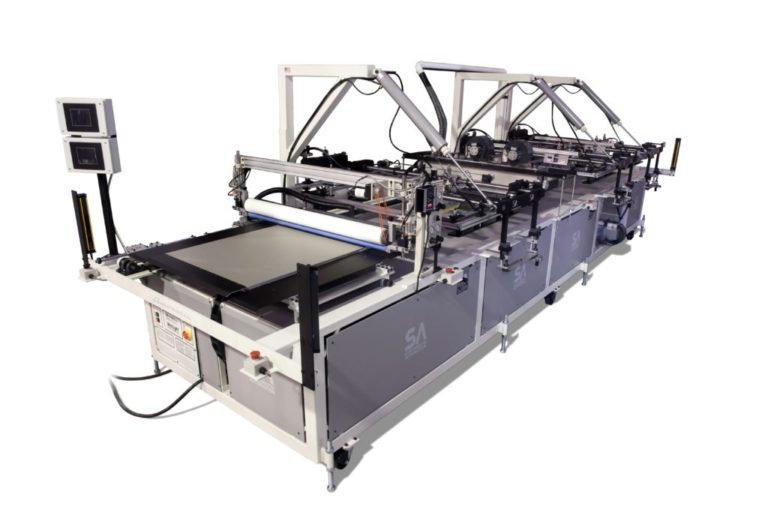
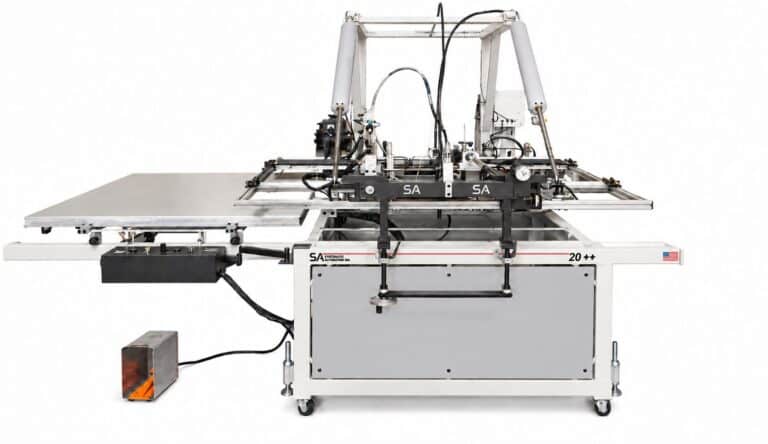
Systems to suit your application and budget
Not sure what you’re looking for? See applications.